CRM Development Company
At Uphead Strategy, we're not just another CRM Development Company think of us as the growth partner who also happens to be good with code. Over the years, we've built custom CRM platforms that map onto how sales, marketing, and support teams actually work, rather than forcing everyone to adjust to someone else's idea of a "best practice" workflow. Whether you're a startup trying to keep pace with a growing pipeline, or an established business juggling years of customer history spread across spreadsheets, sticky notes, and half-used software, our CRM Development Services are designed around your day-to-day reality, not a generic template. The goal is straightforward: give your team one reliable place to see every customer, automate the repetitive parts of the job, and base decisions on real data instead of gut feeling. If fragmented information and missed follow-ups are quietly costing you deals, it might be time for a CRM that's actually built for the way your business runs — not the other way around.
Know About Customer Relationship Management
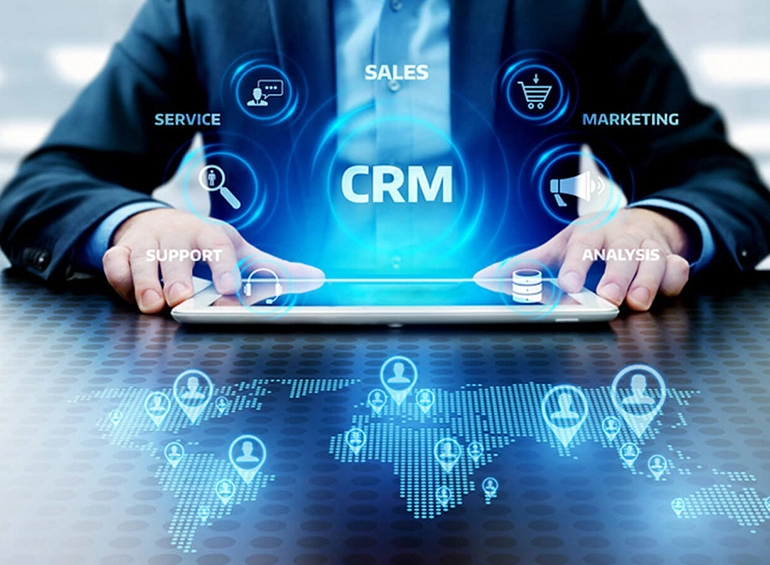
Ask ten sales managers what a CRM actually is, and you'll probably get ten slightly different answers which makes sense, because once it's set up properly, it ends up touching almost everything a business does. At its most basic level, though, a CRM is simply a system that helps you keep track of the people you do business with: existing customers, leads who are still deciding, and everyone somewhere in between.
A modern CRM goes far beyond a digital contact book. It logs every call, email, deal update, and support ticket, so your whole team can see the complete picture of a relationship on one screen instead of piecing it together from memory or old email threads. When it's working well, your sales team spends less time hunting for information and more time actually selling. Your marketing team can build campaigns around real behavior instead of guesswork. And your support team can often spot a problem before it turns into a churned customer.
As a CRM Development company that also offers CRM Consulting Services, we spend time upfront helping businesses figure out what kind of system genuinely fits whether that's Custom CRM Development built from scratch, a heavily customized version of something like Salesforce or HubSpot, or a setup that connects multiple tools you're already using. The point isn't just to have "a CRM." It's to have one your team will actually use.
Our CRM Development Services
Our CRM Development Services cover the full customer lifecycle from the moment someone fills out a contact form to years later, when they've become one of your most loyal accounts. Here's a closer look at what that involves.
Custom CRM Development
When an off-the-shelf platform just doesn't fit, we build a CRM from the ground up around how your business actually operates. That means sitting down with your team early on to map out customer journeys, define workflows, and design modules for lead management, pipeline tracking, contact history, task automation, and reporting before any development begins.
CRM Consulting Services
Not sure which direction makes sense for you? Our CRM Consulting Services start with an honest look at your current processes what's working, where the gaps are, and what a realistic roadmap looks like. The aim is to make sure you invest in the right system the first time, rather than paying for features you'll never touch.
CRM Platform Implementation & Customization
We also work extensively with established platforms Salesforce, HubSpot, Zoho CRM, Microsoft Dynamics, and Pipedrive and take customization well beyond the default settings. That often means building custom objects, rebuilding entire modules, and connecting third-party tools so the platform genuinely behaves the way your business needs it to, not just how it ships out of the box.
CRM Integration Services
A CRM that doesn't talk to the rest of your tech stack just creates more manual work. Our integration team connects your CRM with ERP systems, marketing automation tools, e-commerce platforms, accounting software, and support desks, so every department is pulling from the same real-time data instead of working off separate spreadsheets.
CRM Migration & Data Management
Moving off a legacy system or out of a maze of spreadsheets is often the most nerve-wracking part of any CRM project, and for good reason, since one bad import can mean losing years of history. Our migration process carefully handles extraction, cleanup, and mapping, with validation checks both before and after the move, so you can trust what you're looking at.
AI-Powered CRM Development
We also build intelligence directly into the CRM itself: predictive lead scoring, churn prediction, AI-assisted follow-up emails, and chatbot integrations. The goal is to help your team focus their time on the leads and accounts that need attention right now, rather than sorting through everything manually.
CRM Support, Maintenance & Optimization
Launch day isn't the finish line it's closer to the starting point. We stay involved after go-live for bug fixes, performance checks, new feature requests, and ongoing training, so the system continues to deliver value as your team and processes evolve over time.
Step-By-Step Custom CRM Development Process
Building a CRM isn't something that happens overnight, and we don't pretend it is. Over many projects, we've settled on a process that keeps things transparent, predictable, and most importantly easy to follow from your side of the table.
Discovery & Requirements Gathering
We start with workshops involving your team to understand your goals, your customers, your current tools, and where things tend to break down. Every requirement functional, technical, or integration-related gets documented before any development begins, so there's less guessing later.
CRM Strategy & Architecture Design
From there, our solution architects put together the blueprint: data models, user roles, automation rules, and how everything will connect to your other systems. You'll receive a technical specification document and wireframes for review and sign-off before we move forward.
UI/UX Design
Good design often determines whether a CRM is actually used. We build out user flows, run usability reviews, and refine each screen so the system feels intuitive rather than like one more piece of software your team has to "learn."
Agile Development & Sprint Delivery
Development happens in two-week sprints, with each one producing something you can actually log in and test. Daily standups and sprint demos keep you in the loop, and there's room to shift priorities if your needs change partway through.
Integration & Data Migration
We connect the new CRM to the rest of your business systems and bring over historical data records, deal history, communications carefully, so nothing important gets left behind in the transition.
Quality Assurance & Testing
Before your team logs in for real, our QA process runs the system through functional, performance, and security testing, including scenarios designed to mimic real-world usage under busy conditions.
Deployment & Go-Live Support
Launch is handled as a controlled rollout with hands-on support throughout. We train administrators and end users directly, which goes a long way toward making sure adoption doesn't stall in the first few weeks.
Post-Deployment Optimization
After go-live, we continue to monitor performance, gather feedback from the people actually using the system, and roll out improvements over time. We think of this as an ongoing relationship rather than a one-time handoff.
Why Choose Our CRM Development Agency?
Choosing a CRM Development company is one of those decisions that quietly affects almost every department for years afterward, so it's worth knowing what actually sets a partner apart. Here's where we tend to differ.
Deep Business-Technology Alignment
We see ourselves as a digital strategy partner first and a technology builder second. That means every CRM we design starts with a conversation about your business goals not just a list of technical requirements handed off to a developer.
End-to-End Ownership
From the first strategy session through development, integration, training, and support, we handle the entire engagement ourselves. There's no handoff between teams or vendors, and no finger-pointing if something needs adjusting later.
AI-First CRM Architecture
Rather than treating AI as something to bolt on afterward, we design CRMs with it built in from the start lead scoring, customer segmentation, opportunity forecasting, and automated follow-ups that work as part of the core system, not as an add-on.
Industry Expertise Across Verticals
With around 14 years in this space and more than 100 projects across manufacturing, healthcare, retail, automotive, hospitality, and agriculture, there's a good chance we've already worked through something close to what you're dealing with.
Proven Security & Compliance
Every CRM we build includes role-based access control, encryption at rest and in transit, audit logging, and compliance with GDPR and other relevant data regulations security is part of the architecture from day one, not patched on later.
Measurable ROI
We agree on what success looks like before a project starts and track it as we go, rather than leaving it vague. Clients typically see their sales cycle shorten by 30-50% and lead conversion improve by 25-40% within the first year.
Industry-Specific CRM Software Solutions
Every industry has its own rhythm, and a CRM that works beautifully for one sector can completely miss the mark for another. That's why our CRM Development Services are shaped around the workflows, compliance needs, and customer relationships specific to your industry:
Manufacturing
Keep distributor networks organized, track service contracts, and automate after-sales support instead of chasing it manually.
Healthcare
Manage patient relationships with appointment scheduling, treatment history, and HIPAA-compliant data handling.
Retail & E-Commerce
Bring online and offline customer profiles together, along with loyalty program data and purchase behavior insights.
Automotive
Handle dealer leads, test drive scheduling, financing steps, and after-sales service in one connected system.
Hospitality
Keep guest profiles, booking history, and loyalty tiers organized for genuinely personal service.
Agriculture
Manage farmer and distributor relationships alongside crop advisory workflows and supply chain coordination.
Real Estate
Track your property pipeline, automate follow-up sequences, and offer clients their own portal.
Financial Services
Manage client portfolios with built-in compliance tracking and regulatory reporting support.
Frequently Asked Questions
A custom CRM pulls all your customer data into one place, automates lead follow-up sequences, and gives sales and marketing a shared view of every prospect and customer. That means your reps spend less time on admin work and more time actually selling with lead scoring helping them prioritize who to call next. Marketing, meanwhile, can segment audiences more precisely and trigger campaigns based on real behavior rather than broad assumptions, which usually results in better conversion rates and lower cost per acquisition over time.
It really depends on how complex your requirements are, how many systems need to connect, and how much custom functionality you want. As a rough guide, a foundational custom CRM typically takes 8-16 weeks from start to finish, while larger enterprise builds with extensive integrations and AI features can run 20-32 weeks. Because we work in two-week sprints, you'll usually have working features in hand and in use well before the entire project wraps up.
Yes, and this is one of the things we do most often. We connect CRMs with ERP systems, accounting tools such as Tally, QuickBooks, or SAP, e-commerce platforms, marketing automation software, customer support systems, and communication channels like WhatsApp and email through APIs wherever possible. The goal is for information to move between your systems automatically and in real time, so nobody on your team is left re-entering the same data twice.
As a general benchmark, a standard CRM covering lead management, a contact database, pipeline tracking, basic reporting, and a few integrations is usually delivered in 8-12 weeks. Mid-complexity projects with additional departmental modules and workflow automation tend to run 12-20 weeks, while large enterprise platforms with AI capabilities and multi-region support can take 24-36 weeks. We'll give you a much clearer estimate once we understand your specific requirements during a free discovery call.
AI essentially turns your CRM from a place where data sits into something that actively helps your team work. That can mean predictive lead scoring, churn prediction, automated scheduling, AI-generated call summaries, and personalized email content drafted automatically.
Yes. Once your CRM goes live, we offer ongoing support that covers system monitoring, bug fixes, security updates, performance tuning, and training for new team members. Support plans range from ticket-based help to fully managed service agreements.
More often than people expect. We typically recommend starting with the core functionality your team needs most and adding features incrementally. We also offer highly customized implementations of platforms like HubSpot, Zoho, or Pipedrive, which can deliver many of the same benefits at a lower entry cost.
Implementation means setting up and configuring an existing platform such as Salesforce or HubSpot. It's quicker and costs less upfront. Custom CRM development means building the system from the ground up, shaped entirely around your specific workflows and data. We offer both at Uphead Strategy.